
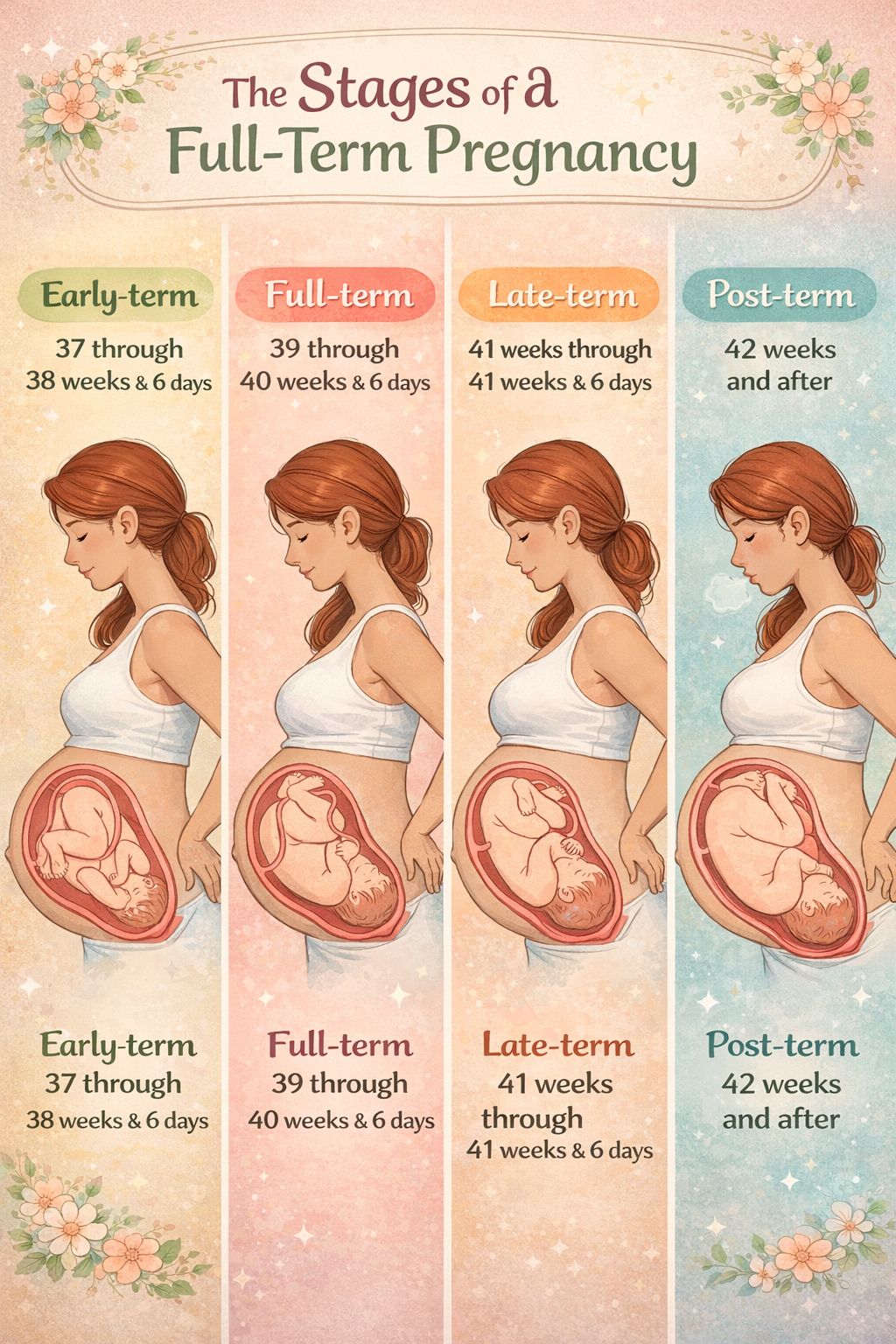
Pregnancy isn’t just “9 months.” It’s a timeline of powerful, precise stages — and every single week matters. 
This visual beautifully breaks down what full-term really means:
 Early-Term (37 weeks through 38 weeks + 6 days)
Baby is considered term, but still putting on finishing touches — especially brain and lung development. Even a little extra time inside can make a meaningful difference.
 Full-Term (39 weeks through 40 weeks + 6 days)
This is the sweet spot. Organs are mature, baby is ready for life outside the womb, and outcomes are generally optimal when delivery happens in this window (unless medical needs suggest otherwise).
 Late-Term (41 weeks through 41 weeks + 6 days)
Many pregnancies safely extend into this phase. Care providers typically increase monitoring to ensure baby and placenta are still thriving.
 Post-Term (42 weeks and beyond)
At this point, doctors and midwives usually recommend closer evaluation and may discuss induction, as the placenta can become less efficient over time.
For parents across the US, UK, Canada, Australia, and Europe — where informed, evidence-based birth planning is part of modern parenting — understanding these distinctions empowers better conversations with healthcare providers.
Because “due date” is an estimate.
Because 37 weeks and 40 weeks are not biologically identical.
Because informed parents make confident decisions.
Every pregnancy is unique. Some babies arrive early and thrive. Some take their time. What matters most is individualized medical guidance, supportive care, and trust in the process.
However your birth story unfolds — early-term, full-term, or beyond — it’s still your strength. 
Disclaimer: This content is for educational purposes only and is not a substitute for professional medical advice. Always consult your healthcare provider regarding pregnancy care and delivery decisions.
Ruchi Singh