Daily Saints – 23 September.
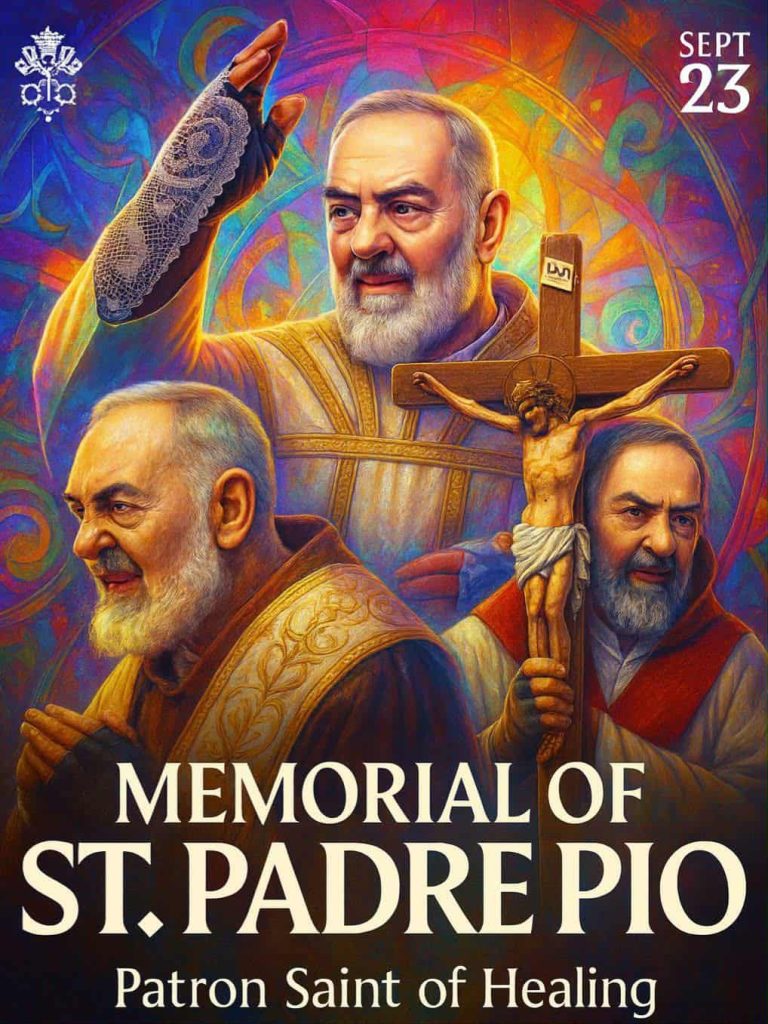
Feast of Saint Padre Pio of Pietrelcina.
He is the patron saint of civil defense volunteers, adolescents, stress relief.
He was born on 25 May 1887 at Pietrelcina, Benevento, Italy as Francesco Forgione to a southern Italian farm family. He was the son of Giuseppa and Grazio Forgione and they were shepherds.
He had an older brother and three younger sisters, as well as two other siblings who died in infancy. As a child, he was very religious and by the age of five he reportedly made the decision to dedicate his life to God.
Fortunately, his parents were also very religious and they supported his Catholic development. His family attended daily Mass. Francisco served as an altar boy at his local parish.
Francisco was known for taking on penances and his mother once scolded him for sleeping on a stone floor. Francisco’s community was also supportive. Saint’s days were popular celebrations and commonly celebrated in his town.
From his tender age, Francisco had a peculiar ability. He could see guardian angels, spoke with Jesus and the Virgin Mary. This was not something taught to him, but occurred so naturally that he assumed other people could see them too.
Although Francisco and his family was very religious, they were also very poor, which required that he work. He spent many years as a child tending to a small flock of sheep owned by his family.
Unfortunately, the work meant he was unable to attend school regularly, so he quickly fell behind other kids his age.
Francisco was sickly as a child. He suffered an attack of gastroenteritis at age six and when he was ten, he had typhoid fever.
In 1897, after three years of schooling, Francisco expressed to his parents that he wanted to become a friar. His parents traveled to a nearby community of monks and asked if Francesco could join them.
He was evaluated, despite his young age, and was told that he needed more education before he could join.
To prepare Francesco, his parents decided to hire a private tutor. To pay the cost of the tutor, Francesco’s father traveled to America to find work, and sent the money home.
At the age of 15, Francisco was finally ready and he entered the novitiate of the Capuchin friars at Morcone. He took the name of “Pio” in honor of Pope Pius I, whose relic he often saw at his local chapel.
At the age of 17, Brother Pio became extremely ill and could only digest milk and cheese. He was sent to the mountain for better air, and when this did not work, he was sent home to his family. Amid all this, he continued to study for the priesthood.
On one occasion during prayer, a fellow monk astonishingly reported he saw Pio levitate during an episode of ecstasy.
Brother Pio became a priest in 1910, but was permitted to remain at home because of his poor health.
In 1915, with World War I afflicting the world, Padre Pio was summoned for military service. He was compelled to leave a tiny community of monks, with whom he was then housed, and drafted into medical service.
However, he was so sickly that he was often sent home, only to then be recalled for service. In March 1916, he was finally dismissed because of his poor health.
Although the cause of his prolonged and debilitating illnesses remained a mystery to his doctors, Padre Pio did not become discouraged.
He offered all of his bodily sufferings to God as a sacrifice, for the conversion of souls. He experienced many spiritual sufferings as well. “I am fully convinced that my illness is due to a special permission of God,” he said.
On July 28th, 1916, he arrived at San Giovanni Rotondo for the first time, and was accompanied by Padre Paolino. This convent was deemed “temporary,” but became his permanent home until his death.
While at the convent, he was given the position of Director of Seminary Teachers. Soon thereafter, a small group of faithful devotees formed around Padre Pio as they sought spiritual direction. This was his first “Prayer Group”.
The marks of the stigmata, the wounds of Christ, appeared on Padre Pio’s body, on Friday, September 20, 1918, while he was praying before a crucifix and making his thanksgiving after Mass.
He was thirty-one years old and became the first stigmatized priest in the history of the Church.
When Padre Pio was hearing confessions when he felt pain in his hands and feet. He noticed the stigmata, the wounds of Christ, appearing on his hands and feet.
The experience was painful. Bleeding occurred. The wounds smelled of roses, and although they continued to weep, they never became infected. Doctors who later examined the stigmata were amazed at their perfectly round shape.
By 1919, word began to spread about Padre Pio’s stigmata and people came from far away to examine him.
Padre Pio became popular with the people he encountered and soon began to attribute supernatural occurrences to him. For example, he was said to levitate, and able to perform miracles.
Due to the long pauses of contemplative silence into which he entered at various parts of the Holy Sacrifice, his Mass could sometimes last several hours.
When asked to shorten his Mass, Padre Pio replied, “God knows that I want to say Mass just like any other priest, but I cannot do it.”
His popularity became a source of concern for the Church and the Vatican began to restrict his activities to minimize public interaction.
Padre Pio himself was uncomfortable with his newfound popularity and the attention he received because of his stigmata. The Holy Office ordered Padre Pio to suspend all of his ministry, except for Mass, which could only be performed alone or without parishioners, and in the interior chapel in the convent.
Throughout this period of segregation, which lasted until July 15th, 1933, he carried out his days in this way: around two hours celebrating Mass; prayers until noon, interspersed with about an hour of study; prayers again in the afternoon, from the evening almost until midnight.
A Church investigation into his stigmata concluded that his condition was not faked. By 1934, the Vatican began to change its attitude towards Padre Pio and he was again allowed to perform public duties.
On July 16th, 1933, Padre Pio was given permission to celebrate Mass again in the church. Later, he was also allowed to hear men’s confessions, and a few months later, also women’s confessions.
At this point, he took up again his ministry as “martyr of the confessional.” Many seeking forgiveness flocked to attain absolution, and their numbers grew at an alarming rate.
His superiors at the convent were forced to develop a system for making reservations to keep the crowds organized and avoid disorder.
Pope Pius XI encouraged people to visit him. In 1947, Fr. Karol Wojtyla visited Padre Pio who prophetically told him he would rise to the highest post in the Church.” Fr. Karol Wojtyla became Pope John Paul II in 1978.
In response to the heartfelt and pressing appeals by Pope Pius’ XII to pray, Padre Pio founded “Prayer Groups.” He said: “Let’s get to work. Let’s roll up our sleeves. Let’s be the first to respond to the Pope’s appeal.”
Padre Pio used his newfound popularity to open a hospital in San Giovanni Rotondo. The facility opened in 1956. He also constructed churches and dedicated day care centers, schools, and a business school.
Pope Paul VI reviewed the controversies surrounding Padre Pio and dismissed any concerns over his conduct and the authenticity of his stigmata.
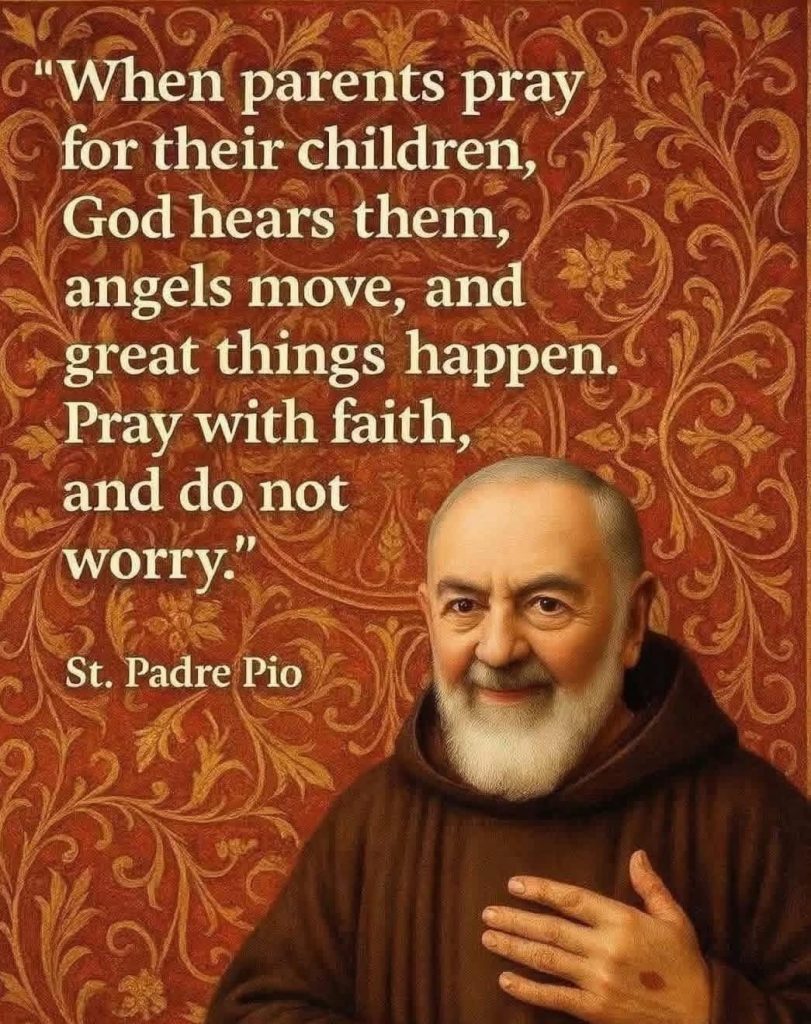
Padre Pio became internationally famous. He was known for his piety, charity and the quality of his preaching. He famously advised, “Pray, hope and don’t worry.”
To his spiritual children he would say, “It seems to me as if Jesus has no other concern but the sanctification of your soul.”
God endowed Padre Pio with many extraordinary spiritual gifts and charisms including the gift of healing, bilocation, prophecy, miracles, discernment of spirits, the ability to abstain beyond man’s natural powers from both sleep and nourishment, the ability to read hearts, the gift of tongues (the ability to speak and understand languages that he had never studied), the gift of conversions, the grace to see angelic beings in form, and the fragrance which emanated from his wounds and which frequently announced his invisible presence.
When a friend once questioned him about these charisms, Padre Pio said, “You know, they are a mystery to me, too.”
Although he received more than his share of spiritual gifts, he never sought them, never felt worthy of them. He never put the gifts before the Giver. He always remained humble, constantly at the disposal of Almighty God.
He loved to pray the Rosary and recommended it to others. To someone who asked him what legacy he wished to leave to his spiritual children, his brief reply was, “My child, the Rosary.”
He had a special mission to the souls in Purgatory and encouraged everyone to pray for them. He used to say, “We must empty Purgatory with our prayers.”
His day began at 2:30 a.m. when he would rise to begin his prayers and to make his preparation for Mass.
He was able to carry on a busy apostolate with only a few hours of sleep each night and an amount of food that was so small (300-400 calories a day) that his fellow priests stated that it was not enough food even to keep a small child alive.
Between Mass and confessions, his workday lasted 19 hours. He very rarely left the monastery and never took even a day’s vacation from his grueling schedule in 51 years.
He never read a newspaper or listened to the radio. He cautioned his spiritual children against watching television.
He had other illnesses, as well, including cancer which was miraculously healed after just two treatments. Other problems, such as arthritis, which plagued him in his later years, never went away.
On September 22, Padre Pio celebrated Mass at 5 in the morning. As he finished, he completely collapsed on the altar. He then went to the confessional to do confession, but was unable due to his condition.
At 10:30, he blessed a large group of people who crowded the plaza in front of the church. Then, at 6:00 in the evening, he blessed the parishioners who had assembled in the church for prayer.
In the small hours of the morning, at 2:30 on September 23, 1968, Padre Pio died, after having the sacrament of confession, renewing his vows, and receiving the sacrament of the anointing of the sick.
Padre Pio died at age 81. He died as he had lived, with his Rosary in his hands. His last words were Gesú, Maria – Jesus, Mary – which he repeated over and over until he breathed his last.
He had often declared, “After my death I will do more. My real mission will begin after my death.”
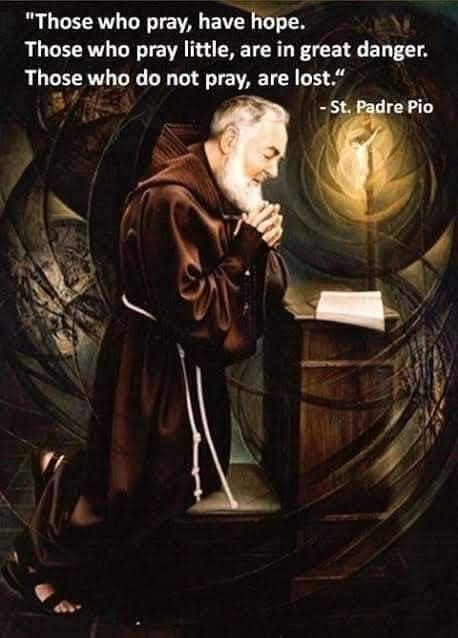
“It is easier for the earth to exist without the sun than without the Holy Sacrifice of the Mass.”
“Prayer is the oxygen of the soul.”
“Pray, hope, and don’t worry. Worry is useless. God is merciful and will hear your prayer.”
“Have courage and do not fear the assaults of the Devil. Remember this forever; it is a healthy sign if the devil shouts and roars around your conscience, since this shows that he is not inside your will.”
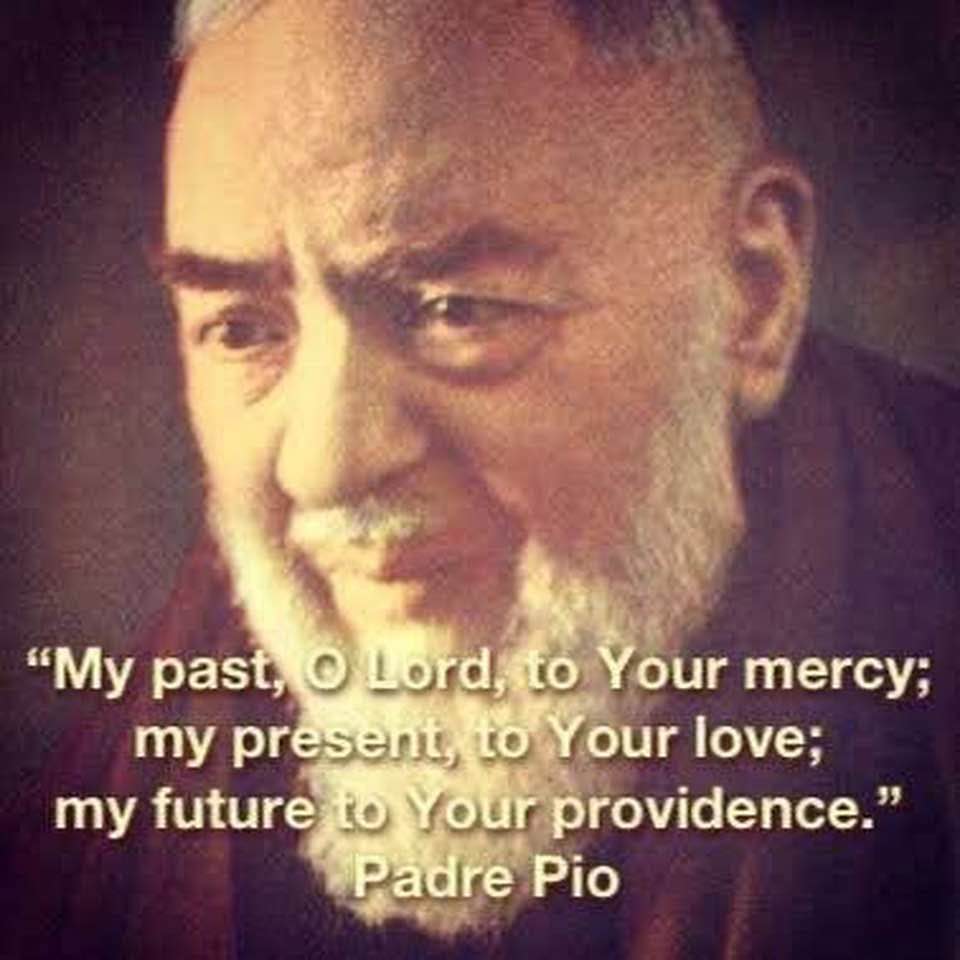
“My past, O Lord, to Your mercy;
my present, to Your love;
my future to Your providence.”
“Joy, with peace, is the sister of charity. Serve the Lord with laughter.”
“Prayer is the best weapon we have; it is the key to God’s heart. You must speak to Jesus not only with your lips, but with your heart. In fact on certain occasions you should only speak to Him with your heart.”
“The life of a Christian is nothing but a perpetual struggle against self; there is no flowering of the soul to the beauty of its perfection except at the price of pain.”
“The most beautiful act of faith is the one made in darkness, in sacrifice, and with extreme effort.”
“Do you not see the Madonna always beside the tabernacle?”
“Fear also seizes Him, and His spirit languishes in mortal sadness.”
“Have patience and persevere in the holy exercise of meditation; be content to begin with small steps till you have legs to run, better still wings to fly.”
“Do not fear. Jesus is more powerful than all hell.”
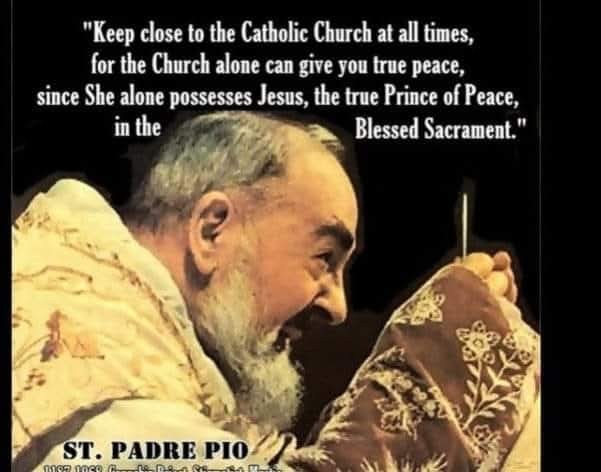
“A thousand years of enjoying human glory is not worth even an hour spent in sweetly communing with Jesus in the Blessed Sacrament.”
“I weep and mourn at the feet of Jesus in the Blessed Sacrament for often I’m consoled.”
“Do not allow the sad spectacle of human injustice to disturb your soul.”
“For your daily transgressions, humble yourself, humble yourself, always humble yourself.”
“If you should fail, be humble, make a resolution to be submissive to God’s will and then get up, and carry on.”
“Humanity wants its share. Even Mary, the Mother of Jesus, knew that through His death, man would be redeemed, and yet She cried and suffered, and suffered much.”
“Fear is an evil worse than evil itself.”
“It is difficult to become a saint. Difficult, but not impossible!”
“Humility is truth; truth is humility.”
“Have great confidence in God’s goodness and mercy, and He will never abandon you; but don’t neglect to embrace His holy cross because of this.”
“Suffering, no matter how difficult it may be, when compared to the good that is accomplished, makes every pain a joy for the soul.”
“Take God to the sick; it will be worth more than any other cure!”
വിശുദ്ധ പാദ്രെ പിയോയുടെ ജീവിതത്തിൽ നിന്നു പഠിക്കേണ്ട 5 പാഠങ്ങൾ
ഇരുപതാം നൂറ്റാണ്ടിലെ ഏറ്റവും വലിയ ക്രൈസ്തവ മിസ്റ്റിക്കുകളിൽ പ്രധാനിയാണ് വി. പാദ്രെ പിയോ. 1887 മേയ് 25നു ഇറ്റലിയിലെ ബെനവേന്തോ എന്ന ചെറുപട്ടണത്തിലായിരുന്നു ജനനം ഗേസിയോ മാരിയോ ഫോർജിയോനും മരിയ ഗീസെപ്പയുമാണ് മാതാപിതാക്കൾ. ഫ്രാൻസിസ്കോ എന്നായിരുന്നു പിയോയുടെ മാമോദീസാനാമം. 15-ാം വയസ്സിൽ കപ്പൂച്ചിൻ സന്യാസ സമൂഹത്തിൽ പ്രവേശിച്ച പീയോ, 19-ാമത്തെ വയസ്സിൽ കപ്പൂച്ചിൻ സഭയില് അംഗമായി വ്രതം ചെയ്തു. ഇരുപത്തിമൂന്നാമത്തെ വയസ്സിൽ 1910 ആഗസ്റ്റു മാസം പത്താം തീയതി പൗലോ ഷിനോസി മെത്രാപ്പോലീത്തയിൽ നിന്നു തിരുപട്ടം സ്വീകരിച്ചു. 1918 സെപ്തംബർ 20 -ാം തീയതി മുപ്പത്തി ഒന്നാമത്തെ വയസ്സിൽ ആദ്യമായി ശരീരത്തു പഞ്ചക്ഷതമുണ്ടായി. സഭാ ചരിത്രത്തിൽ പഞ്ചക്ഷതമുണ്ടാകാൻ ഭാഗ്യം ലഭിച്ച ആദ്യ വൈദീകനാണ് പിയോ അച്ചൻ. സാൻ ജിയോവാനി റോന്റോണ്ടോ ആശ്രമത്തിൽ 51 വർഷം ജീവിച്ച വി. പിയോ ഒരിക്കൽപ്പോലും അവധി എടുത്തട്ടില്ല. ഈശോ മറിയം നാമം ഉച്ചരിച്ചുകൊണ്ടു 1968 സെപ്തംബർ 23-ാം തിയതി 81 -മത്തെ വയസ്സിൽ പാദ്രെ പിയോ സ്വർഗ്ഗത്തിലേക്കു യാത്രയായി. 1947 ൽ വൈദീകനായിരിക്കെ പിയോ അച്ചന്റെ അടുക്കൽ കുമ്പസാരിക്കാൻ പോളണ്ടിൽ നിന്നു വന്ന ജോൺ പോൾ രണ്ടാമൻ പാപ്പയാണ് 2002 ജൂണ് 16നു പിയോ അച്ചനെ വിശുദ്ധനായി പ്രഖ്യാപിച്ചത്. വിശുദ്ധ പാദ്രെ പിയോയുടെ ജീവിതത്തിൽ നിന്നു പഠിക്കേണ്ട 5 പാഠങ്ങൾ നമുക്കു മനസ്സിലാക്കാം.
1. ദിവ്യകാരുണ്യ ഭക്തി
“എന്െറ ശരീരം ഭക്ഷിക്കുകയും എന്െറ രക്തം പാനം ചെയ്യുകയും ചെയ്യുന്നവന് എന്നിലും ഞാന് അവനിലും വസിക്കുന്നു.” (യോഹന്നാന് 6 : 56). പാദ്രെ പിയോയുടെ ജീവിതം ഈശോയോടു കൂടിയാണ് എന്നും ആരംഭിച്ചിരുന്നത്. രാവിലെ 2:30 നു ഉണർന്നിരുന്ന ഫാ. പിയോ മണിക്കൂറുകൾ പ്രാർത്ഥിച്ചൊരുങ്ങിയാണ് ബലിക്കു തയ്യാറായിരുന്നത്. പ്രഭാത ബലികൾ മണിക്കുറുകളോളം നീണ്ടിരുന്നു. വിശുദ്ധ കുർബാനയുടെ മഹത്വം തിരിച്ചറിഞ്ഞതുമൂലമുള്ള ആത്മ നിർവൃതിയിലും പഞ്ചക്ഷതങ്ങളുടെ തീവ്രമായ സഹനങ്ങളും മൂലമായിരുന്നു വിശുദ്ധ കുർബാന ദീർഘനേരം നീണ്ടു നിന്നിരുന്നത്. .
വിശുദ്ധ കുർബാനയില്ലാതെ ലോകത്തിനു നിലനിൽക്കാനാവില്ല എന്ന വി. പിയോയുടെ പ്രബോധനം ഭുവന പ്രസിദ്ധമാണ്. ലോകം മുഴുവനും അതിന്റെ നിലനിൽപ്പിനായി വിശുദ്ധ കുർബാനയെ ആശ്രയിക്കുന്നു. പരിശുദ്ധ കുർബാനയെക്കുറിച്ചു രണ്ടു കാര്യങ്ങളാണ് പാദ്രെ പിയോയുടെ ജീവിതത്തിൽ നിന്നു പഠിക്കാൻ കഴിയുന്നത്. ഒന്നാമതായി വിശുദ്ധ കുർബാന ബലിയാണ് എന്ന യാഥാർത്ഥ്യം. വിശുദ്ധ കുർബാന നമ്മുടെ കർത്താവിന്റെ കാൽവരിയിലെ ബലിയുടെ പുനരവതരണമാണ്. ആത്മീയമായി ഓരോ ബലിയും ഈശോയുടെ പീഡാനുഭവം, മരണം ഉത്ഥാനം എന്നി പെസഹാ രഹസ്യങ്ങളിലേക്കു നമ്മളെ പ്രവേശിപ്പിക്കും. രണ്ടാമതായി, വിശുദ്ധധ കുർബാനയെ നമ്മൾ എപ്രകാരം സമീപിക്കണ മെന്നു വി. പിയോ പഠിപ്പിക്കുന്നു. എത്രമാത്രം ഭയഭക്തിയോടും സ്നേഹത്തോടും കൂടി കർത്താവിന്റെ ബലിവേദിയെ നാം സമീപിക്കുന്നുവോ അത്രമാത്രം നമ്മൾ അതു വിലമതിക്കും, എത്രമാത്രം വിശുദ്ധ കുർബാനയെ നാം വിലമതിക്കുവോ അത്രമാത്രംമാത്രം വിശുദ്ധ കുർബാന നമ്മുടെ ജീവിതത്തെ രൂപാന്തരപ്പെടുത്തും.
2. പരിശുദ്ധ കന്യകാമറിയത്തോടുള്ള ഭക്തി
മറിയം പറഞ്ഞു: ഇതാ, കര്ത്താവിന്െറ ദാസി! നിന്െറ വാക്ക് എന്നില് നിറവേറട്ടെ! അപ്പോള് ദൂതന് അവളുടെ മുമ്പില് നിന്നു മറഞ്ഞു.(ലൂക്കാ 1 : 38). പാദ്രെ പിയോയിക്കു പരിശുദ്ധ കന്യകാമറിയത്തോടു അതിരറ്റ സ്നേഹമുണ്ടായിരുന്നു. 1913 പിയോ എഴുതിയ ഒരു കത്തിൽ ഇതു വളരെ വ്യക്തമാണ്: ” നമ്മൾ ഇവിടെ അമ്മയുടെ മനോഹരമായ മാസത്തിന്റെ അവസാനത്തിൽ എത്തിയിരിക്കുന്നു… ഈ പ്രിയപ്പെട്ട അമ്മയ്ക്കു എന്റെ മേലുള്ള ശ്രദ്ധ ഈ മാസവും സമൃദ്ധമായി തുടരും. അവൾ എന്നെ അതിരറ്റ സ്നേഹത്തിലേക്കു നയിക്കുന്നു… അഗ്നി അല്ലങ്കിലും ഞാനൊരു കനലാണ് . ഈ അമ്മ വഴി മകനായ ഈശോയോടു ഞാൻ ചുറ്റപ്പെട്ടിരിക്കുന്നു. എല്ലാ സൃഷ്ടികളെയും ഈശോയുടെയും മാതാവിന്റെയും സ്നേഹത്തിലേക്കു ക്ഷണിക്കാൻ ഞാൻ പറക്കാൻ ആഗ്രഹിക്കുന്നു.”
വളരെ കുറച്ചു മാത്രമാണു പാദ്രെ പിയോ രാത്രിയിൽ ഉറങ്ങിയിരുന്നത്, തന്നോടു പ്രാർത്ഥന യാചിച്ചവർക്കു വേണ്ടി ജപമാല ചെല്ലിയാണ് രാത്രി കാലം ചെലവഴിച്ചിരുന്നത്. മധ്യസ്ഥ പ്രാർത്ഥനകളിൽ പാദ്രെ പിയോയിക്കു ഏറെ ഇഷ്ടം ജപമാല പ്രാർത്ഥനയായിരുന്നു. “ഈ കാലഘട്ടത്തിന്റെ ആയുധം ” എന്നാണ് വി. പിയോ ജപമാലയെ വിളിച്ചിരുന്നത്. ജപമാല പിയോയിക്കു മഹത്തായ സമ്പത്താകാൻ കാരണങ്ങൾ രണ്ടാണ്; ഒന്നാമതായി സുവിശേഷ സന്ദേശങ്ങൾ അതിന്റെ പൂർണ്ണതയിൽ ആഴമായി ജപമാലയിൽ സന്നിഹിതമാണ്. രണ്ടാമതായി മറിയത്തിന്റെ പ്രാർത്ഥഥനയുടെ പ്രതിധ്വനിയാണ് ജപമാല.
3. വിശുദ്ധ കുമ്പസാരം
“അതുപോലെതന്നെ, അനുതപിക്കുന്ന ഒരു പാപിയെക്കുറിച്ച് ദൈവത്തിന്െറ ദൂതന്മാരുടെ മുമ്പില് സന്തോഷമുണ്ടാകും എന്ന് ഞാന് നിങ്ങളോടു പറയുന്നു.”(ലൂക്കാ 15 : 10) കുമ്പസാരകൂട്ടിൽ മണിക്കൂറുകൾ ചെലവഴിച്ചിരുന്ന വൈദീകനായിരുന്നു വി. പാദ്രെ പിയോ. ആത്മാവിൻ്റെ വിശുദ്ധീകരിക്കുന്ന വിശുദ്ധ കുളിയായാണ് കുമ്പസാരത്തെ പിയോ അച്ചൻ കണ്ടിരുന്നത്. പൗരോഹിത്യ ജീവിതത്തിന്റെ പ്രാരംഭ ദശയിൽത്തന്നെ നല്ലൊരു കുമ്പസാരക്കാരൻ എന്ന പേരു ഫാ: പിയോ നേടിയിരുന്നു. അദ്ദേഹത്തിന്റെ അടുക്കൽ കുമ്പസാരിക്കാൻ പത്തു ദിവസമെങ്കിലും കാത്തിരിക്കണമായിരുന്നു. 1950 മുതൽ പാദ്രെ പിയോയുടെ അടുക്കൽ കുമ്പസാരിക്കുന്നതിനായി കപ്പൂച്ചിൻ സഭ മുൻകൂട്ടി ബുക്കു ചെയ്യുന്ന രീതി അവലംബിച്ചു. ചില ദിവസങ്ങളിൽ പതിനഞ്ചു മുതൽ പത്താമ്പതു വരെ മണിക്കൂറുകൾ പിയോ അച്ചൻ കുമ്പസാരക്കൂട്ടിൽ ചെലവഴിച്ചിരുന്നു. ആത്മാർത്ഥതയില്ലാതെ കുമ്പസാരത്തിനണയുന്നവരെ തിരിച്ചറിയാനും അവരുടെ പാപങ്ങൾ ഓർമ്മപ്പെടുത്തി ശരിയായ അനുതാപത്തിലേക്കു നയിക്കാനും വി. പാദ്രെ പിയോയിക്കു സവിശേഷമായ കഴിവുണ്ടായിരുന്നു. വി. കുമ്പസാരത്തെ സ്നേഹിക്കാം, ആത്മാർത്ഥതയോടെ കരുണയുടെ കൂടിനെ സമീപിക്കാം.
4. എളിമ
“ശുശ്രൂഷിക്കപ്പെടാനല്ല, ശുശ്രൂഷിക്കാനും അനേകരുടെ മോചനദ്രവ്യമായി സ്വജീവന് കൊടുക്കാനും മനുഷ്യപുത്രന് വന്നിരിക്കുന്നതുപോലെ തന്നെ.”(മത്തായി 20 : 28). ജീവിതകാലത്തു ധാരാളം തെറ്റി ധരിക്കപ്പെട്ട വ്യക്തിയായിരുന്നു ഫാ. പിയോ. ഒരിക്കൽ ഒരു വൈദീകൻ പിയോയിക്കു എതിരാായി വ്യാജ പ്രചരണങ്ങൾ പ്രചരിപ്പിച്ചു. ഈ വൈദീകൻ മറ്റേതോ കാരണത്താൽ ജയിലിലായി, പിന്നീടു വിമോചിതനായപ്പോൾ ആദ്യമേ തന്നെ കാണാനായി ഫാ: പിയോയുടെ സമീപമെത്തി. തിരിച്ചു വന്ന ധൂർത്ത പുത്രനെ സ്വീകരിക്കുന്ന പിതാവിന്റെ സ്നേഹവാത്സല്യയത്തോടെ പിയോ ആ വൈദീകനെ സ്വീകരിച്ചു .
ചിലർ അദ്ദേഹത്തിന്റെ പഞ്ചക്ഷതം വ്യാജമാണന്നു പറഞ്ഞു പരത്തി. എല്ലാ സഹനങ്ങളും ക്രിസ്തീയ ഉപവിയോടെ പിയോ സ്വീകരിച്ചു. വി. പാദ്രെ പിയോയുടെ എളിമയെക്കുറിച്ചു വി. ജോൺ പോൾ രണ്ടാമൻ പാപ്പ പറയുന്നതു ഇപ്രകാരമാണ്. ” ദു:ഖങ്ങളും ബുദ്ധിമുട്ടുകളും സ്നേഹം മൂലം സ്വീകരിച്ചാൽ അവ വിശുദ്ധിയിലേക്കു രൂപാന്തരപ്പെടുത്തുന്ന വഴിയാകും അവ ദൈവത്തെ അറിയാൻ കഴിയുന്ന വലിയ നന്മയിലേക്കു നമ്മുടെ വാതായനങ്ങളെ തുറക്കും.”
വി.പിയോയെപ്പോലെ എളിമയെ സ്നേഹിക്കാം വിശുദ്ധിയിൽ വളരാം
5. കാവൽ മാലാഖയോടുള്ള ബന്ധം
“നിന്െറ വഴികളില് നിന്നെ കാത്തുപാലിക്കാന് അവിടുന്നു തന്െറ ദൂതന്മാരോടു കല്പിക്കും.
(സങ്കീര്ത്തനങ്ങള് 91 : 11). കാവൽ മാലാഖമാരോടുള്ള ബന്ധത്തിൽ വിശുദ്ധ വി. പാദ്രെ പിയോ ഭുവന പ്രസിദ്ധനാണ്. 1913 ൽ തന്റെ ആത്മീയ മക്കൾക്കെഴുതിയ കത്തിൽ കാവൽ മാലാഖമാരോടുള്ള സുഹൃദ് ബന്ധം പരിപോഷിപ്പിക്കാൻ പിയോ എഴുതുന്നു: “അമ്മയുടെ ഉദരത്തിൽ തുടങ്ങി കല്ലറ വരെ നമ്മെ സമാശ്വസിപ്പിക്കാനായി ഒരു ആത്മാവ് കൂടെയുള്ളത് എത്ര ആശ്വാസമാണ്. ഒരു നിമിഷം പോലും, നമ്മൾ പാപം ചെയ്യാൻ ധൈര്യപ്പെടുമ്പോഴും നമ്മളെ ഉപേക്ഷിക്കാതെ കൂടെ നിൽക്കുന്ന ഈ സ്വർഗ്ഗീയ ആത്മാവ് നമ്മളെ ഒരു സുഹൃത്തിനെപ്പോലെ സഹോദരനപ്പോലെ നയിക്കുകയും സംരക്ഷിക്കുകയും ചെയ്യും.”
മറ്റൊരിക്കൽ പിയോ ഇപ്രകാരം എഴുതി: “ ഈ നല്ല മാലാഖ നിങ്ങൾക്കു വേണ്ടി പ്രാർത്ഥിക്കുകയും നിങ്ങൾ ചെയ്യുന്ന എല്ലാ നല്ല പ്രവർത്തികളും നിങ്ങളടെ പരിശുദ്ധമായ ആഗ്രഹങ്ങളും ദൈവത്തിനു സമർപ്പിക്കുകയും ചെയ്യുന്നു എന്നു തിരിച്ചറിയുക.” വി.പിയോയുടെ മാതൃക സ്വീകരിച്ചു നമ്മുടെ കാവൽ മാലാഖമാരോടുള്ള ബന്ധത്തിൽ വളരാം.
ഫാ. ജയ്സൺ കുന്നേൽ mcbs